vendredi 10 juin 2016

Hautpoul--A Medieval Village

Village sign
After lunch in Albi we headed home; our plan was to stop in whatever little hamlet caught our attention.  Jason remembered seeing a sign for a medieval village on the Carcassonne side of Mazamet, just before making the steep climb up into the Black Mountains.  We managed to spot it just in the nick of time and made our way down and then up, up, up a winding, narrow, barely-one-lane road--kind of like a logging road.  

Main Street?

In the other direction

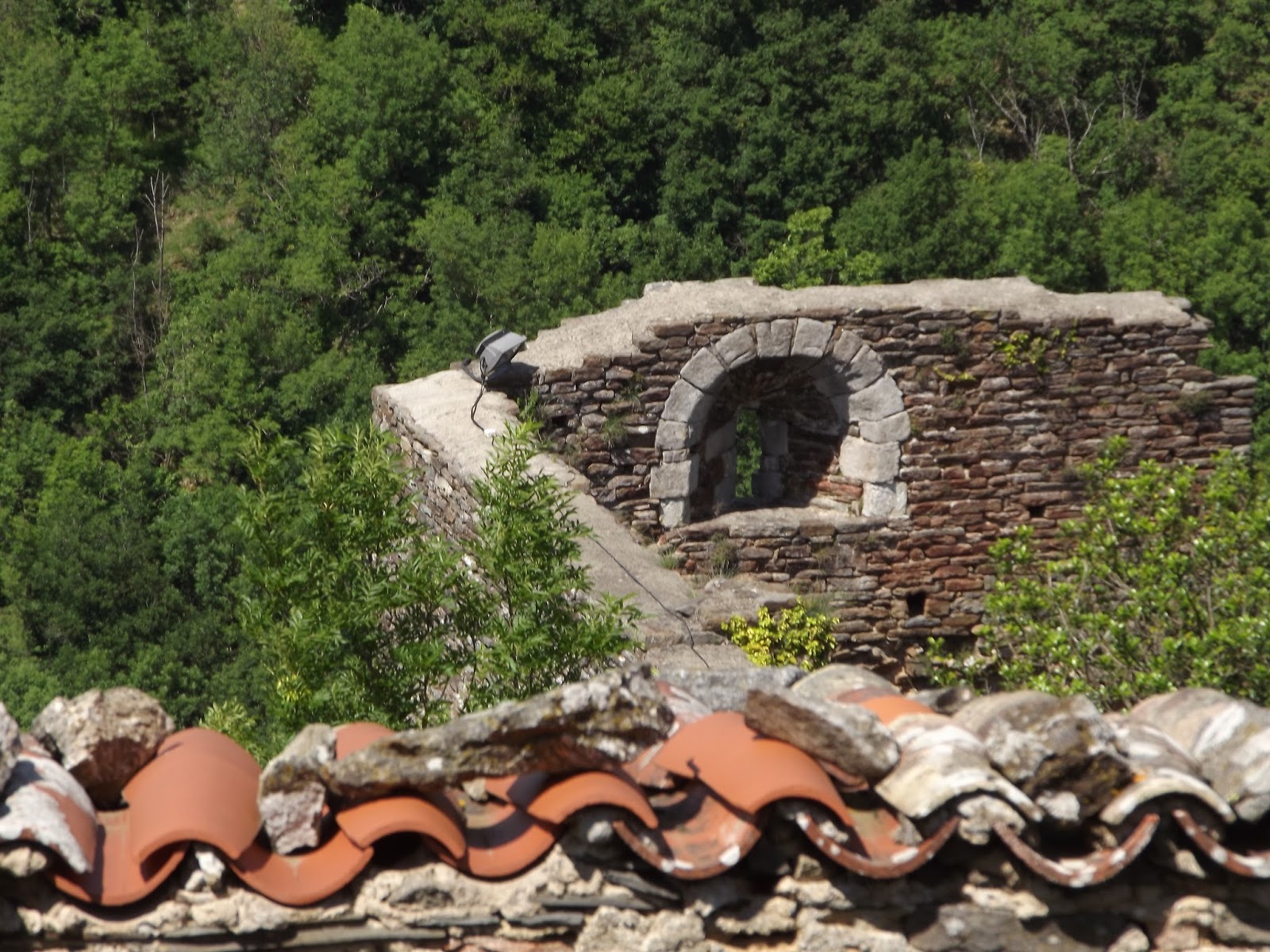
We passed this ruin on the way in
Although we kept our fingers crossed and hoped not to encounter oncoming traffic, we were not lucky.  We did meet an oncoming car with perhaps the most inconsiderate driver ever, who REFUSED to back up to the wide spot where we could have passed.  So we were forced nearly into the side of the mountain--and jackass driver barely squeaked by, our respective side mirrors almost touched.  I thought it would be fun to come up the road on a motorcycle and Mary opted for a horse.  Certainly a tour bus wouldn't dare attempt it!  

Tidy stone cottage with roses

Charming and worth the trouble to get to
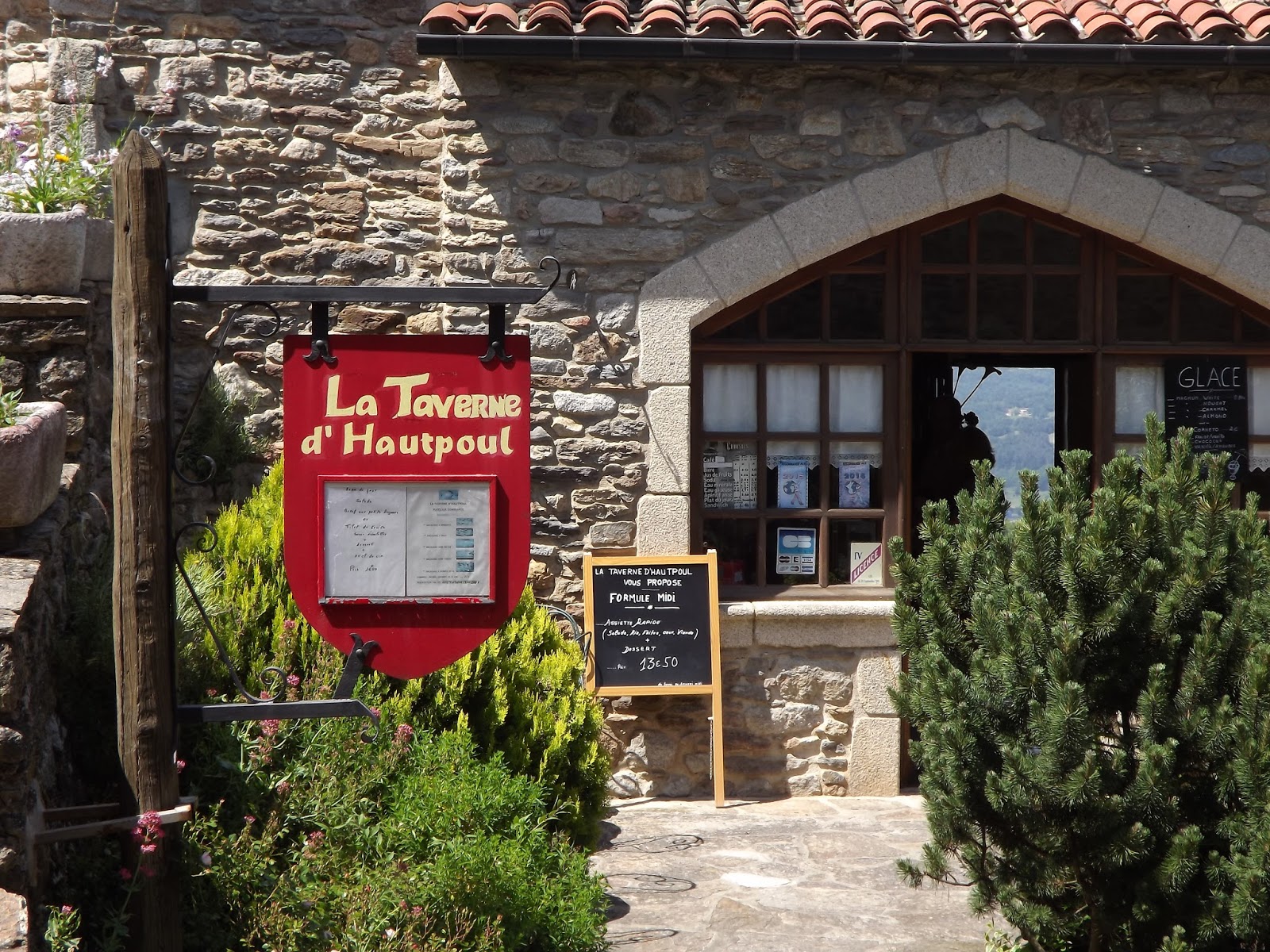
The road opened up at the top of the cliff to a statue of the Virgin Mary watching over the entire valley.  A little walk took us into the village, and I use that term in the loosest possible sense.  There are presently maybe 10 houses, some definitely occupied, others shuttered and silent, clinging to the side of a mountain .  The "street" ends at cliffside and the Tavern of Hautpoul.  Stone is the building material of choice, and there is certainly plenty of it.  The houses that still stand have a well-loved feel, even if most are probably only summer residences.
Remnants of older fortification

Down in the valley--a tannery or perhaps a mill on the river

This is a fascinating place.  It has been fought over and besieged, its residents forced to leave.  For the life of me, I cannot understand why.  You practically have to be a goat to get there, and God only knows how hard it had to be to bring in supplies.  It is encapsulated, and the residents could easily adopt a let us alone attitude, and probably did.  I was not one bit surprised to find that Simon de Monfort had his bloody hands on the place.  He was going to get rid of that "nest of heretics."  These Cathar last-stand sites are remote, difficult to access.  Why people can't let others alone is one of the greatest mysteries to me.  God knows I have my hands full just trying to keep my own life on track and there's not anything left over for trying to manage someone else's.

Tempted?

We had a drink of water out on the terrace of the Tavern.  It was run by a little dot of a woman, a twinkle in her eye and a ready laugh.  She confirmed my speculation that the marvelous tree in the "square" up the street was a chestnut--actually a marronier.  It was hosting a nightingale who was singing his heart out.  What a glorious sound!  She also told us that while she doesn't get hordes of tourists, there are those who find their way there as part of the pilgrimage path, especially the San Jacques de Compostelle journey.

Great old chestnut tree in the town square

Statue of Virgin Mary stands vigilant


Jason could not see the allure of living there, but I could.  At least for a period of time to write, to reflect, to soak up the history of this fought-over place. Maybe that way I could get a better understanding of why it was so desirable.

View from the statue's perch to Mazamet below

I am sure these caves also sheltered people who were hunted in the name of religion


jeudi 9 juin 2016

Albi--Cathedral

"Holy Christ" was all I could say
Eglise Sainte Cecile, Albi's cathedral, is arguably the main attraction in the city.  I have not seen huge numbers of cathedrals, but I have seen some, so I was sort of prepared to be impressed.
Ever present rain gutter gargoyles

When I rounded the corner however, a "Holy Christ," involuntarily escaped me.  Out loud, even.  I wasn't prepared for its size, its outward simplicity, which is really a trick.  The "Church of Saint Cecelia is intricate indeed.
One block of marble?

One of my favorite ceilings


We are watching you!
Compared to the shabbiness of the "big" churches in Carcassonne, Sainte Cecile seems to be doing relatively well financially.  I detected no odor of mold and mildew, most of the ceiling still wears its blue coat of paint, the frescoes are clean and bright, as was the woodwork on display, there were new pews.  Note that they still don't have padded seats like churches in the US, but the wood was bright and shiny and the joints were still tight.  I am glad to see that they are able to preserve this monument. Watching these edifices crumble is not pleasant, no matter what my feelings are about the Church that owns them.  So I was happy to see Albi's cathedral thriving.


Holding up the organ is hard work

Decorate every last square centimeter


An angry angel?
I must continually remind myself to imagine the power of the 13th century (and earlier) Catholic church.  People were superstitious, fearful, uneducated and the Church was the ruler of their daily lives in a way I cannot experience.  It governed what to wear, what to eat and when, when to work, when to play.  It ruled how they thought, how they greeted outsiders,  and God help you if you happened to be female.  As much as I chafe at those rules, I have to remember to view these buildings through those lenses.
Elaborate altar


Passing through the portals with all those likenesses gazing down on me, I could see the " Let us show you what REAL power looks like,"attitude that led to the building of this edifice.  The Cathars had been exorcised and the church wanted to impress the citizenry as to who were the true bosses and thus built this cathedral.
Imagine the detail!

I confess to liking the blue color


Inside I found myself completely overwhelmed, and not necessarily in a good way.  I am a person who loves the simplicity of Shaker lines and the minimalist style of decor.  This church combines either the best or the worst (depends on your point of view) of the visual excesses of the Catholic church, the Moorish love of decoration and the French need to make sure that every square centimeter of a surface has been painted, carved, or gilded. 

Ironwork at one of the side "chapels"

I will let the photos speak for me.  The next time I visit the cathedral, I will leave my camera outside and make my next trip a guided one.  I am sure that all of those painted and carved faces have names, tell a story or a parable or honor some hero of the Catholic fight for the domination of the citizenry's hearts and minds.  I will, on my next visit, make sure to see the "treasure," as I was too busy looking at all the decoration and trying to get the perfect photo to do one more thing.  

Sainte Cecile's little "chapel"

She gets a padded kneeler (sorry for the blir)     

Impressive woodwork
 And truly, I need time to process the evidence of what I think is excess, and probably made possible by squeezing every possible sou from people who could better have used it in their own households.  So, yes, I have a definite love hate relationship with the Catholic Church of past times.  

Graceful arches

View through the carvings

Light and darkness

Albi--The Town Center

Clandestine meeting point?

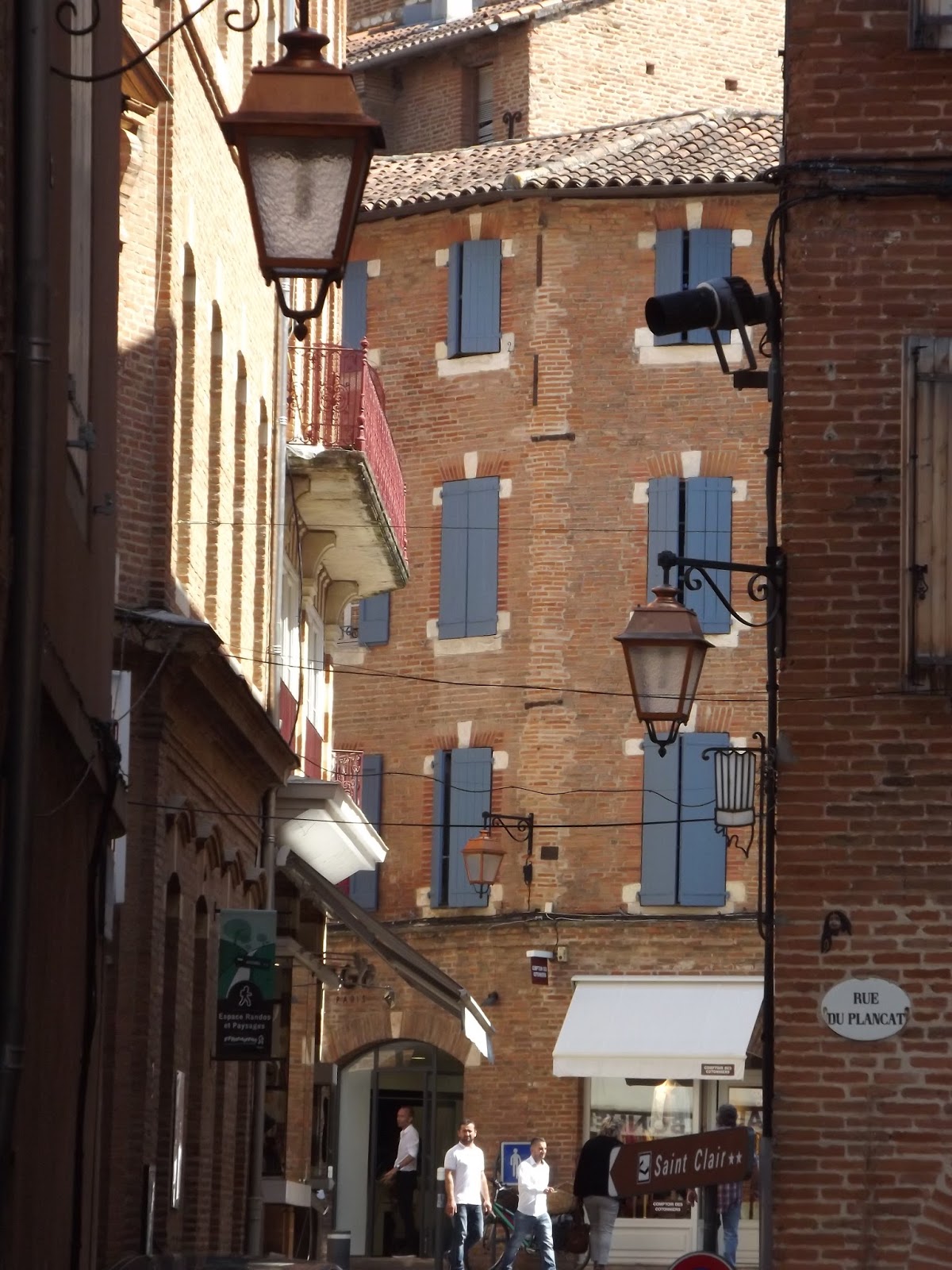
High buildings and narrow streets


Loggia on the top floor
I was  curious to see Albi.  Maybe I could find in the buildings some clues as to why it was such a hotbed of revolt against the Catholic Church in the 13th century.  After all, the Crusade wasn't called the "Albigensian Crusade" for no reason.  I still struggle with the concept that history sold us a bill of goods when referring to the Crusades as an attempt to "save" the Holy Land from heathen Muslims.  This crusade was an joint effort of the Pope and the King of France to eradicate French citizens and, oh, by the way, confiscate all their property.  So pardon me if I cough at the notion of virtuous motives.
Brick in need of restoration

The city must have been really something to witness in medieval times.  The town center is a maze of streets lined with 4 and 5 story buildings of brick and wood.  They must have been the skyscrapers of the day.  I can't go back and revisit the time, but Albi has the feel of having been a prosperous, progressive city.
Restaurants invite us


Skyscrapers of their day


I loved the architecture.   Brick abounds, and is decorated with patterns and designs.  Shutters provide color.  Many facades are half-timbered.  The cathedral and nearby buildings are full of curves. I tried imagining what market day around the cathedral must have been like--the colors and the smells and sounds of all manner of vendors advertising their goods.  
The upper floors cantilever out over the street

Present-day Albi probably has its own version of urban blight, but I wasn't downtown long enough to discern that.  While my thoughts are wandering off to who lived in these buildings and what kind of lives did they lead, Jason, ever-pragmatic, drew my attention to some renovation work that was going on in one of those tall brick structures and remarked upon the difficulty of getting construction materials up to the top floors and the rules the remodelers must have to follow about what work is and is not allowed to look like, especially exterior work.
Mary and Jason check out the menu.  We lunched here.
 

Interior courtyard and tea room

Brick, timbers, colorful shutters


Nearing the Cathedral

Decorative brick work.  Bet the chocolate vendor is Dutch?

What stories are contained in this home?
When I think of history as a series of truths, connected to individuals and their stories, I find Albi and its inhabitants, past and present, to be a fascination that I intend to explore further.  Fortunately, it's served well by the train system and is certainly worthy of a weekend or several day's wandering.  

On the wall of a restaurant.


Ceremony in Albi

Albi's monument to those "Mort pour la France"
After finding covered parking in Albi, we headed off toward the "downtown" section, and the Cathedral.  Interesting, isn't it that we three all decline to use maps.  I am not sure that's always the best course of action, but really, how lost could we get?
Lining the steps

This says it all
I spotted a rectangular plaza where obviously something was going to happen.  There were men and a few women dressed in military uniforms, and dozens of flags being carried.  I spotted a brass player, and a podium and a cordoned-off area with seats, obviously for the dignitaries.  My camera and I suggested that we go see what was happening.
Honored dignitaries


At that point the trumpeter sounded a fanfare--a call to attention.  The sash-wearing dignitaries assembled for a short walk to the seating area and one man in uniform took the podium.  More fanfares followed.  He read a statement informing us that they'd gathered here to honor the French soldiers who'd given their lives in Indo-China.

Waiting to begin


The solemnity whole thing caught my be the throat.  I found my eyes tearing up at what I was witnessing.  The French LOVE their ceremonies and take them very seriously, even small ones such as this. It wasn't well attended, mostly by a few visitors who'd stumbled upon it.  They were in bright uniforms, wearing sashes, waving flags.  The trumpet player, as usual, cracked on the fanfares.  In terms of "professionalism" it was sadly lacking, as, honestly, most of these ceremonies I have witnessed have been. 
The musicians


But something about it touched me.  This is a people determined to never forget.  They don't simply discard their history, which is a double-edged sword, I am also learning.  It didn't matter that the ceremony was sparsely attended; what mattered was the doing of it.  There's a lesson there.

Officiating


Field Trip North

Fields of red poppies outside of the Carcassonne city limits

Yesterday Jason took my upstairs neighbor, Mary, and me on a little drive to Albi, a city north-northwest of Carcassonne.  It was a glorious day, sunny, borderline hot in the direct sun, not too humid, not too windy.  There was not too much traffic, and certainly not too many tourists.


The quickest way to Albi is to take the toll road to Toulouse and then head northeast.  That was not for us.  Our route took us over the Montagnes Noirs--the Black Mountains and into the region known as the Tarn.  I loved seeing the changes in the countryside.  Before reaching the mountains, we went through the Cabardez--scrubby and dry.  The soil is light in color; this is due to all the limestone, I think.  The bushes have a grey tint to them and vineyards here produce some of the best wine of the Aude.  
Climbing up into the Black Mountains

Could the yellow be broom?
The climb up into the mountains is so subtle I hardly realized it was happening until I found myself surrounded by deep woods with vast valley vistas when there were breaks in the roadside vegetation.  I saw what I think was broom covering some of the hillsides. Soon enough the broad valley vistas gave way to steep gorges, heavily wooded and with a river at the bottom too far down to discern.  Descending the Black Mountains was steep, winding and reminded me of the drive through the canyon to Medford--but with different trees. 

A side road up in the Black Mountains

Once on the other side of the mountains, we passed through Mazamet, a once important banking and tannery and textile center.  Even though it is of some size, it has a very isolated feel to it.  An hour away by car from Carcassonne, it takes three on the train, because you have to go to Toulouse first.  Officially now in the Tarn, I noticed some changes in the countryside on this "other" side of the Black Mountains.  
Mazamet

The soil was redder; obviously it contains more clay.  Thus, the crops were different.  Still very agricultural, this part of France doesn't have so many vineyards.  Instead of little fields hemmed in by hedgerows, there were bigger fields, many with newly cut hay.  I recognized alfalfa and saw young corn plants testing the sun and the air as they began their climb.  I also spotted some Holstein cows; a rarity here.  This countryside felt more and more like Frederick County, where I grew up.

The "other" side of the mountains--steep and heavily wooded


We passed through Castres, another city of some size and then reached our destination: Albi.  That's for another post.
Are there faces in the caves?

jeudi 2 juin 2016

Here's Looking at You, Char

Facing forwad

I got another cooking lesson this week.  I bought my first fresh shrimp from the fishmonger--I love that word--to serve as aperos (appetizers) at a dinner party. I have had some good frozen ones, but wanted these to be fresh.  Come to think of it, I am not sure when I have ever purchased truly fresh from the sea shrimp, not ones that have been flash frozen ...maybe once in South Carolina at the shrimp boat docks.


I asked the fishmonger when I should cut the heads off--before or after cooking them.  He looked at me quizzically and gave me a rapid-fire dripping with a southern French accent  answer that made no sense to me.  I thanked him and went on about my marketing.  I would get to the bottom of this elsewhere.

When I stopped in at the tabac, Marie's sister was there and I asked her for help.  In true French fashion, everyone else who came in to the store in the next 15 minutes had some input as to the best way to prepare shrimp.  We opened up the bag, examined the little critters and finally, the verdict.
These shrimp were already cooked. Since I was not going to use them in a hot appetizer, I should just go home and twist off their little heads, shell them and keep them cool until it was time to serve them.

 A Closer Look
Apparently most shrimp are sold like this--already steamed with their heads on.  No wonder the fishmonger had looked at me oddly when I asked him about cooking them.  I would like to think that I would have figured that out on my own, but how wonderful it is to have this entire support network of French people who love to give me culinary advice. All those customers in that tabac probably went home that afternoon for lunch and brought with them the tale of this American woman and the shrimp, and how they were able to set her straight as to the finer points of shrimp cooking.  

The shrimp were delicious--sweet and tasting faintly of the sea.  I found that I could rip their little heads off with not one trace of squeamishness.  Growing up on a little farm and raising your own Sunday dinner chickens will do that for a person.  I learned that I have to be more attentive to the shells--these were not as tough as those already frozen and are easily missed in the shelling process.  This particular batch had eaten well, so their black lines were plump and easily removed.  The beheading process is now de-mystified....

Aperos for 3!!

Who knows, maybe one day I will attempt the calamari!