samedi 2 février 2019

Gaillac Chinese Lantern Festival

Gaillac Festival of Lanterns
Gaillac is a small town between Toulouse and Albi, a little northwest of Carcassonne, in the Tarn.  Their main claim to fame is wine--they have a renowned white, or so I am told.  But they also are home, for two months to the Feeries de Chine--the Chinese Lantern Festival.  

Debbie and Martin arrive in Gaillac

The town is decorated a la Chinoise

But their Christmas decorations are still up, adding to the festive air
I tried to get to this festival last year, but couldn't get my act together to get a hotel and train tickets booked in a timely fashion.  Last year was the first, and even then it sounded interesting to me.  This year, I was determined that I was not going to miss it.  There was also more publicity about it this year, and it seemed like they were expecting crowds, so timing the visit was important to me.  I absolutely did not want to visit it during school holidays...please God, spare me from the hordes of children and teenagers.  Well behaved as they may be, they still present issues of crowds and jostling for a view.  Then I had to work around some doctor appointments and some other activities.

The Entrance--notice the overhead lights in red and blue

One of the buildings

Another building with dragons and the moon
I had mentioned it to my friends Debbie and Martin, to see if they had any interest in going.  It would involve a hotel stay and train tickets, and then working their schedules into the equation.  Finally, the spoiler was finding a hotel with two rooms available.  That sounds simple; it was not.
Eventually I was able to get us rooms and booked the train tickets.  We were on our way to Gaillac.

Some of the "tableaux"--scenes of people working 

Colorful boat ont he waves

Horse, wagon and driver

Woodworker (I think) at his bench

Lady of the house and her worker

What could they be talking about?
What's for dinner?

Important on the Silk Road

It is an easy train trip from Carcassonne--there's a change in Toulouse to a commuter train that runs to Albi. Even with all the "milk run" stops, we were in Gaillac in time to slide under the deadline for lunch service.  After getting warmed up and filled up, we set off in search of our hotel, which was a little bit out of the main town, but certainly not far.  After checking in, I had a little nap and we met up again to walk to the park where the huge light display was shining over the city.

Flower Garden
Stylized flowers maybe 3 - 4 feet high

Reflected in a building window

More colors

Closer inspection--silk, wire and lights....amazing

I don't know exactly what I expected--a lot of Chinese lanterns in different colors and sizes, perhaps.  But what I found was mind-blowing.  Actually I had read about it in one of the Sunday paper supplements, but even though I had read that there were over 1000 silk-covered sculptures, I had not imagined what that would look like.

Imperial Palace
 
The jewel

Imperial musicians

And the dancer twirled
As it turned out, our timing was perfect.  There was absolutely no line to get in as we were all required to pass through security--one line for women, one for men.  There was never any
feeling of being jostled or hurried along.  I even managed to get some nems--kind of like egg rolls and didn't have to wait in line.  Around 7:30ish there was some minor crowding in front of some of the more spectacular displays like the Imperial Palace.  Bu the whole display covers acres and we felt no sense of being crowded.  There were some children, but not many.  (School night).  I|t wasn't raining, or snowing, which it was expected to do the next day. 

The Elephant and the Dog
 
Porcelain tied in long strips

I so want one of these cups and saucers

There were 4 of these big guys

Jeweled dog And the red "falling star lights in upper right

Up close
I am not going to take time to describe everything I saw. I will let the photos speak for themselves. Highlights for me were the Imperial Palace, and the elephants made of porcelain cups and saucers fashioned using the rope techniques that were used 1000 years ago to shop the precious and fragile porcelain.  I am not a visual processor, so all of this was overwhelming for me.  I found myself falling into my usual pattern of minutiae--a habit I cannot seem to break.  It was hard for me to capture the scale of the exhibits--the Imperial Palace had to be 8 stories high.  In some of the photos you will be able to see the occasional silhouette of people; that should serve to show you how big these exhibits were.

The Dragons 

What a face

Colors in his head

Face-off

Detail on the dragon body

 It was magical--the weather, while not raining at the moments we were in the park, wasn't fabulous.  It was muddy and a bit raw, but we had dressed for the occasion.  It could have been 30 or it could have been 80, I was transported.  

Homage to Their Hosts
 
Wine domaine--wine being "poured" into the glass

Red and black rugby

Rgby and the Cog--the symbol of Gaillac

A nod to Gaillac's wine industry

Dancing waters

Next year, I am going back for two nights.  I know there were lots of things that I missed. I was pretty pleased with the way my photos turned out, as night time photos are a special challenge for me.  I never did get a really good photo of the hundreds of red lanterns hanging overhead.  I so wanted to bring home a red lantern, or actually several small red lanterns to hang in a column from my window. 

A Few Odds and Ends

One of my very favorites

White rhinos and the best shot of the hanging red lanterns

Abacus

Fan

On the Silk Road

The festival ends on the 6th of February. 

mardi 15 janvier 2019

Costa Brava--Lunch at the Seashore

REminds me of the southern Oregon coast
After leaving the Roman town of Peratellada, we drove to the coast for lunch.  My first glimpse of the Mediterranean's incredible blue elicited the same response from me that the view in Port Ordord, Oregon does to first time visitors.  I have seen the Med before, bet never in such a "wild" setting, through the trees high above and traveling through twisting, turning narrow back roads to reach it.  I was suitably impressed, believe me.
Blue and white stripes of Tamariu

We were lunching in Tamariu--a little cove spot on the beach barely larger than a hamlet.  But it's obvious that it's a destination for playing in the water and most of all, dining on fresh catch from the waters.  

Blue and white were the theme colors of the building, awnings, umbrellas.  There's a wide terrace, a very short boardwalk and steeply wooded hills on three sides.  The Med is the fourth, but the cove is so sheltered that it's hard to eve imagine it angry in this spot. Everyone there ws dining outside, and even though it was 3:00, late for lunch even by Spanish standards, we had to wait half an hour for a table.  
Dining in the sun

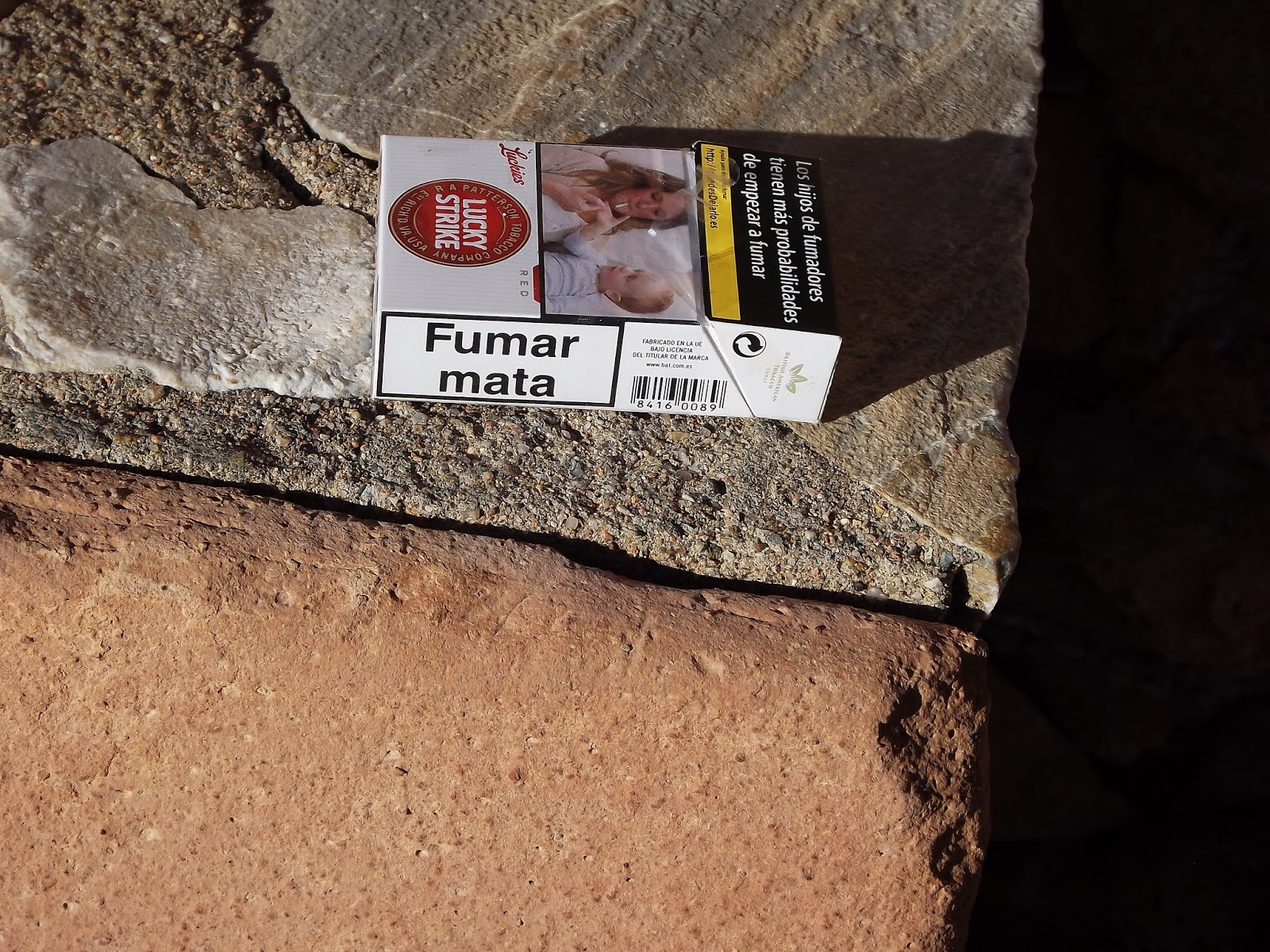
I took a little walk along the path that hugs the shore line.  The town fathers have placed ceramic-tiled benches that fairly insist that you stop, sit and reflect on the color of the water, the wildness of the hillsides, that wave crashing against the rocks, but un the cove, only lapping a tht sand.  Someon left an empty cigarette package on one of the benches, the warning "Smoking Kills" prominently in view.  The French and the Spanish don't beat around the bush about the dangers of smoking.  
Cigarette package warning

One of the Med's many blues

Art on one of the rocks along the shore lune path

By the time I returned to the restaurant, our tanle was ready....and a glass of sangris seemed just he thing to have on a sunny Catalonian afternoon at the beach.  We split an appetizer of chiparones, which are deep fried baby squid.  Barbaric as that might sound, they are nonetheless delicious.  Georges and Veronica had fresh fish--sea bream and turbot, respectively, while I had a typical Catalan of chorizo and roasted green peppers (all of which I gave away) over frites, topped with two perfectly runny-yolked eggs.  I was in heaven, it really hit the spot.  I have developed a taste for Catalan sausage and the chorizo was a tad spicy but delicious.  
Tamariu

We finished dinner as the sun was setting over the ridge and the temperature dropped noticeably. It was time to head home to the apartment. Dinner that night was bread and cheese--I could not possibly have managed more after that lunch.  

Little beach in front of the board walk
 One of the things I made sure to do while I was in Palamos was to check out bus service to these places from Girona.  There's plenty and it's regular, so a car is not absolutely necessary to enjoy this Costa Brava of Spain.  I cannot wait to return.
This could be Curry County, Oregon

jeudi 10 janvier 2019

Costa Brave--Perratellada

After descending the peak via a decidedly less twisty and turn-y road, we headed toward the sea.  Our next destination was Peratallada, a restored Roman town.  We hadn't much time, as our stomachs were announcing that lunch should be coming up soon.  My stomach hadn't gotten the message quite thoroughly that times for the midday meal in Spain are much later than it is accustomed to, even in Carcassonne.  Lunch times in Spain generally start after 2, and often run as late as 3 or 3:30.  Our lunch was waiting for us at the seashore, so we had just enough time to skedaddle through the town and get back on the road.
Narrow sunless streets


Stone upon stone
Humans have been living in Peratallada for millenia.  The first impressions are of stone--everything is built of the smallish stones pulled out of the soil, not quarried in blocks.  I think of the perseverance and the skill it would have taken to gather them, and then fit them into walls that have stood the test of 1000 years.  The Romans and the Greeks knew a good spot for a town when they saw it.  Of course, it has the ever-present encircling walls to keep out marauders who wanted to take things that did not belong to them.  
Hanging easrs of corn on one porch

Brick work arches
Mailbox in the side of a stone-walled building

Mediterranean blie 

the second impression was of immaculateness.  There was not a cigarette butt in sight, the paint was fresh in most cases and the  bougainvillea was blooming as if ordered to do so be a film director.  The place is charming, but I cannot imagine how slick and slippery everything would be in a downpour.  Some shops were open, some restaurants welcomed diners.  It was plenty warm in the sun, but cool in the very narrow alleys that didn't get much direct sun.  It always comes as a bit of a shock when I can stand in the middle of a "street" and just about touch the walls of the buildings on either side of me.  It just reminds me again of how small and slight a race of people are these Catalonians and how big I must seem to some of them.
Stone and local pottery

This guy found his sunny spot


There are people who do live and work inside the walls, maybe even more so than in Carcassonne.  I got the impression that it takes some serious money to live there and maintain your property to accepted standards.  Everything was in great repair--and there was some interesting non-Roman architecture.
This caughty my eye

I likes some of their Christmas decorations very much, especially the tree that had no ornaments.  Instead it had tag board messages for best wishes hand written and placed on the branches by prior visitors.  Such a nice way to leave a message, instead of spray-painting it on walls.
Greeting left by a previous visitor

Tied to the tree instead of lights and shiny ornaments
Shadow of the very simple municipal Christmas decorations

Veronica pointed out what she called Roman chariot ruts worn deep into one of the stone streets.  I don't know about chariots on such a narrow alley, but I am fully prepared to believe that those scars were made by years and years of carts.  As always, I wondered about how lived there, what their lives were like, what they dreamed of and how they viewed their world.  

Wagon ruts


And isn't that the purpose of these sites?
Bouganvillea

Cascading blooms

Laundry or curtains?

mardi 8 janvier 2019

Costa Brave--Santuari dels Angels

View from the peak
Those who know me well know that I am a back roads kind of gal.  I much prefer taking the slow routes just to see where they lead.  We did just that when we left the train station at Girona.  Georges programed Fifi, the GPS navigator to take the scenic route to Palamos from Girona.  Actually, I think if you take the auto route, it's only about 29 kilometers from Girona to the coast, but we weren't really in a hurry and we did want to see some sights along the way.

We had not counted on just how twisty and turn-y the road would be.  For my Oregon friends, it was something like mile after mile of the worst parts of Carpenterville Road, or 199, through the canyon.  Georges did a great job of driving and avoiding the many cyclists coming down the mountain.  Many many pine trees surrounded us; and I saw my first cork trees.  Very interesting.  Technically we were crossing the Massis de Gavarres.  There were unexpected little farmhouse restaurants out in the middle of nowhere, and just like on Carpenterville Road, I recognized the occasional driveway or more accurately, track, with a chain barring entrance to curiosity seekers.  Keep out is a universal signal.
Looking back toward Girona

When we reached the top of the massif,  we discovered a lovely whitewashed complex, obviously a church and based on its location, it had to have spectacular views.  It did not disappoint.  We pulled into the parking lot and began our walk around the complex.  The name of it is Santuari dels Angles--the Sanctuary of the Angels.  What a lovely name!  And it has 360 degree views.  To the south you can see the Med.  To the northeast, we could see the Pyrenees from what for me is the "back" side.  I was surprised that there wasn't more snow, even on Canigou.  I have a feeling this weekend's forecasted weather will remedy that. Even so, they were stunning.
Lovely to find a sanctuary at the end of the road

It turns out that the church was the one in which Salvador Dali was secretly married.  This area of Spain is Dali country; he lived and worked here and I think there is at least one museum of his work located in the area.  The church itself is modest and unassuming inside.  There were a few stained glass windows and a stone in the floor indicating a date in the 1600's, so it's been around a while.  
At the altar

1683

Paul? looks unhappy.
A Google search revealed that it is actually a sanctuary--a place for a retreat.  There is an 18 room hotel on premises, but certainly not overdone with "amenities."  It's clean, safe, and there are windows that actually open to let in the mountain air.  Groups and individuals use it for retreats.  There's a building with a multipurpose room that I thought might be used as part of the chruch;'s Sunday school facilities, but now I think it's use extends to people who come for all manner of retreat activities.  And I peeked in one of the windows of the restaurant, which probably serves very good food. There is a huge terrace outside to enjoy the sunshine and the views.  

Outdoor eating area to enjoy the sunshine and the views
It would be hard to leave such a place if I were staying there.  It was hard to leave even though i wasn't staying there, but there were other places to see and lunch was waiting for us on the beach.

Never tire of this view